
Most meetings work fine, until they don’t. The room is too large for voices to carry. Someone keeps interrupting. The delegate who needs an interpreter can’t follow what’s being said. And by the time the chair regains control of the floor, the agenda is already running behind.
A conference system fixes these problems at the source. Not by adding complexity, but by giving every participant the tools to be heard, and giving the chair real control over the discussion.
In this article, we explain what a conference system is, what it does, and why organisations from city councils to international summits use them.
What is a conference system?
A conference system gives every meeting participant their own microphone, speaker, and, depending on the setup, a request-to-speak button, access to interpretation channels and voting. Modern systems do much more than amplify voices. They manage who speaks, when, and in what language.
The global conference system market was valued at USD 706 million in 2024 and is projected to reach USD 980 million by 2033 (Market Reports World, 2024). That growth reflects something real: the need is no longer limited to parliaments and international bodies. Boardrooms, council chambers, and mid-sized conference venues are all part of this.
These systems come in many forms:
- Flushmount delegate units installed in permanent chambers
- Wired or wireless tabletop units for temporary or travelling setups
- Fully integrated AV solutions for broadcast-ready or hybrid events

The hardware varies. The goal is consistent: every voice gets heard, the discussion stays on track, and something is documented at the end.
1. Audio that works for everyone in the room
Bad sound kills meetings. When someone at the far end of the table can’t hear what’s being discussed, they stop following. They ask for things to be repeated. The whole room loses its rhythm.
A conference microphone system gives each seat its own dedicated unit, typically a gooseneck or tabletop microphone with echo cancellation built in. Nobody needs to shout. Nobody cranes forward to hear the person three seats away. Speakers use a normal voice and everyone can follow along.
For large venues (council chambers, plenary halls, conference rooms that seat 200 or more), this matters in a way that’s easy to underestimate. A single handheld mic passed between delegates does not work at that scale. The audio is inconsistent, the logistics slow everything down, and the whole thing feels improvised.
Most of our work at duvall however isn’t in large halls. It’s in a meeting room with 15 to 20 people: a project review, a working session, a half-day with clients. At that size, dedicated equipment can feel like overkill. It usually isn’t. Someone speaks too softly. Someone turns away mid-sentence. There’s a participant joining from Antwerp who’s catching maybe half of what’s said. A conference microphone at each seat fixes that. People stop leaning forward. The “sorry, could you repeat that?” interruptions disappear. The meeting just runs.
2. Structured discussion that doesn’t require a referee
Anyone who has chaired a large meeting knows the feeling: multiple people wanting the floor at once, someone talking over a colleague, a delegate who has been waiting twenty minutes starting to look visibly frustrated.
Request-to-speak systems handle this mechanically. A delegate presses their button; their name or seat number appears on the chair’s screen. The chair decides who speaks next, sets time limits, queues the floor. For more informal sessions, automatic open-mic modes are available.
What this actually changes is the power balance. The chair has real authority, backed by the system rather than personality alone. The process is also visible: every delegate can see where they are in the queue. No more arguments about who had their hand up first.
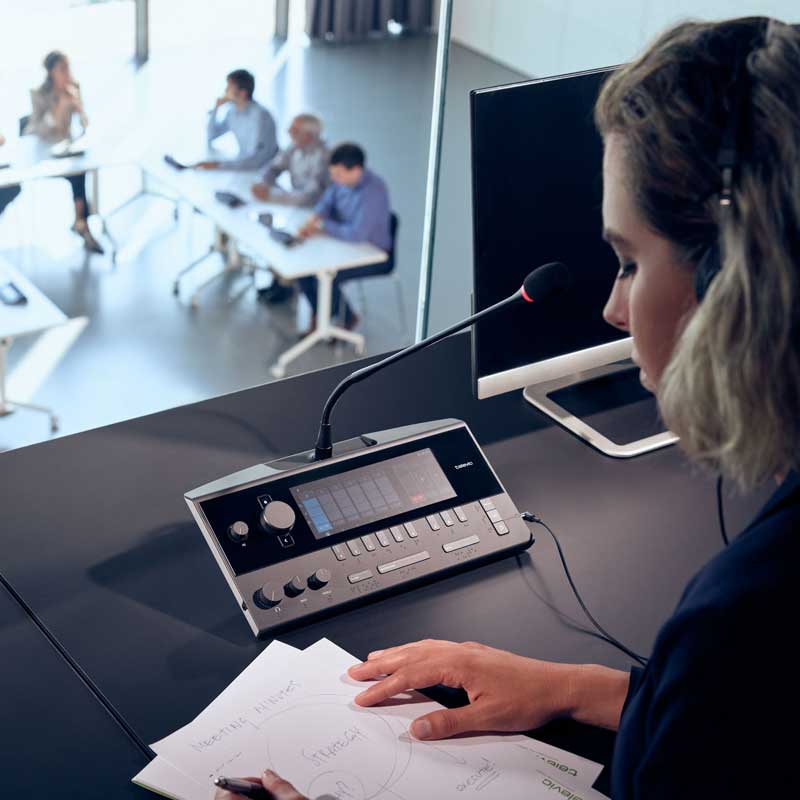
The Televic Confidea G4 Flex, the unit we deploy at events ranging from local authority meetings to EU ministerial summits, packages all of this into a single tabletop unit with a 5.2″ touch screen.
3. Simultaneous interpretation without the awkward pauses
Running a meeting across languages is difficult. Consecutive interpretation, where the speaker pauses while the interpreter translates, can double the length of a session. It breaks the rhythm of debate and often makes speakers hesitant to elaborate.
With simultaneous interpretation, the conversation doesn’t stop. Professional interpreters listen in real time and translate through a separate audio channel, transmitted wirelessly to headsets. Delegates hear everything in their own language as it’s being said.
Our ISO-compliant interpreter booths, wireless transmitters, and channel-selectable headsets support meetings in two languages or fifteen. The interpretation feeds connect directly to the conference microphone system, so there’s no separate audio chain to manage alongside everything else.
For EU institutions, international NGOs, or multinational businesses, this is basic infrastructure. Without it, you don’t really have a meeting; you have a translation exercise with voting at the end.
4. Hybrid meetings that actually work
Hybrid meetings have a bad reputation, and usually for good reason. One camera at the back of the room, a single microphone picking up the whole table, remote participants staring at a ceiling trying to work out who’s talking.
With in-room microphones, cameras, and streaming tools connected to Zoom, Teams, or Webex, the picture changes considerably. Automated camera tracking follows whoever is speaking, with no manual operator needed. Remote participants hear the room clearly; in-room delegates can see and respond to remote speakers on screen.
We’ve configured these hybrid setups for corporate boards and parliamentary sessions alike. The aim is always the same: remote participation should feel like participation, not like watching a recording after the fact.
5. Electronic voting that produces results in seconds
Some meetings end with a show of hands. That works for twelve people in a boardroom. It doesn’t scale to 80 delegates in a council chamber where the chair has to count, recount, and handle disputes about who raised their hand.
Electronic voting, integrated into the conference system, gives each delegate a vote from their microphone unit or a dedicated handset. Results are on screen in seconds, accurate to the individual.
What you get with integrated voting:
- Instant results on screen: no counting, no disputes
- A full audit log per delegate, with timestamp and ID
- Live polling during sessions to keep audiences engaged
- Data that feeds straight into post-meeting reports
6. Recording and streaming as standard, not as an extra task
Good meetings produce decisions. Decisions that aren’t documented tend to dissolve somewhere between the conference room and the following morning.
A conference system records the entire session automatically (audio and video) as a byproduct of the event rather than a separate task. Live streaming to external audiences or remote delegates runs in parallel when needed. Content is archived in formats that work with standard document management systems.
For public bodies with transparency requirements, this handles compliance. For organisations that need board minutes and decision records, it removes a manual step. And even for internal meetings: when three people walk out with three different versions of what was agreed, having the audio is the quickest way to settle it.
7. One system that scales from twelve to twelve hundred
There’s a version of a conference system that suits a boardroom and a version that suits a plenary hall at an international summit. In well-designed systems, these are not entirely different products; they’re the same modular platform deployed at different scales.
A portable wireless setup can be packed into transport cases and moved to any venue. A fixed installation can be extended when needed. Core components stay consistent across deployments, which keeps maintenance manageable.
We’ve handled this kind of multi-scale deployment for over 30 years, from city council meetings to NATO gatherings and Belgian EU Presidency events. The configuration changes with the event; the underlying approach stays the same.
Who actually needs a conference system?
Here are the organisations where a conference system tends to make the biggest difference:
- Government and public bodies (municipal councils, parliaments, regulatory authorities), where procedural records and equal access to the floor are legal requirements, not preferences
- International and multilingual organisations (NGOs, EU institutions, multinational businesses), where simultaneous interpretation is basic infrastructure
- Corporate boards and governance meetings, where decisions need to be documented and voting needs an audit trail
- Conference venues, hotels, and event organisers, who need to deliver a professional experience reliably, across a wide variety of clients and formats
Conference systems are also not exclusively for permanent installations. Rental options, which we offer alongside our own events support, give organisations access to professionally configured equipment for a single event, with no capital investment and nothing to store afterward.
How to choose the right setup
The right conference system depends on a handful of variables. Before specifying anything, we typically ask:
- How many participants, and how is the room laid out?
- Is the meeting in-person, hybrid, or fully remote?
- How many languages does the session need to support?
- How much moderator control does the chair need?
- Is this a permanent installation or a one-off event?
Finding a partner who understands the operational side matters as much as the hardware. A system that works brilliantly in a permanent chamber needs different thinking for a temporary setup in a hotel ballroom.
We’ve been doing this for over 30 years, supporting national and international governments, NGOs, businesses, and institutions across Europe. As a premium member of the Televic Conference Rental Alliance, we provide equipment and on-site technical support for events of any scale.
From discussion to decision
Meetings are infrastructure. A meeting where everyone can hear clearly, where discussion is structured, and where decisions are documented is a real operational improvement, and not a complicated one to achieve.
The right conference system is what makes that possible. Not a luxury for large institutions. A practical investment for any organisation where meeting outcomes actually matter.
Want to know what the right setup looks like for your event?
Talk to us, we’re sure we can help.
Additional Sources:
Conference System Market Size & Share, Market Reports World (2024)
Televic Conference: Discussion Systems & Parliamentary Solutions
Conference Room Solutions Market, Future Market Insights (2025)